
Commission Sales: Definition, Structure, and Best Practices for 2026
Commission sales drives revenue growth by aligning compensation with results. In 2026, businesses face a new challenge: Gitnux reports that 80% of B2B sales interactions now occur in digital channels, requiring commission structures that account for multi-touch attribution and content-driven deals. For sales development teams and Account Executives managing complex B2B cycles, traditional commission models no longer capture the full picture of modern selling.

Skip Manual Research - Apollo Finds Contacts Fast
Tired of spending 4+ hours daily hunting for contact info? Apollo delivers 224M verified contacts with 96% email accuracy. Join 550K+ companies who eliminated manual research.
Start Free with Apollo →Key Takeaways
- Commission sales compensates reps based on closed revenue, motivating performance and aligning incentives with business outcomes
- Modern B2B commission structures must account for digital-channel attribution, content contributions, and multi-stakeholder deals
- SDRs, AEs, and RevOps teams need clear commission frameworks that reflect long sales cycles and complex buying journeys
- Technology integration with CRM and marketing automation platforms enables accurate attribution and fair compensation
- Effective commission plans include governance, clawback provisions, and transparent calculation methods to prevent disputes
What Is Commission Sales?
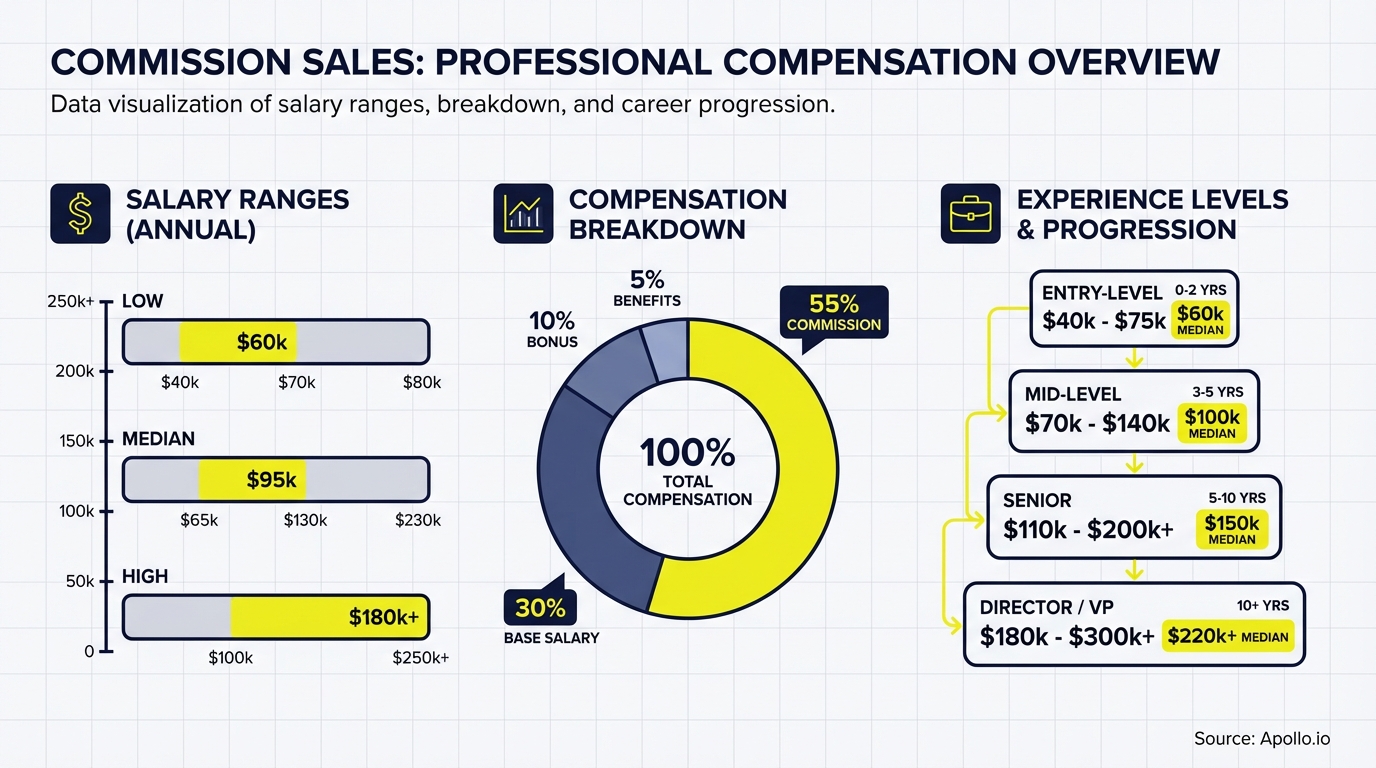
Commission sales is a compensation model where reps earn a percentage of revenue from closed deals. Unlike fixed salaries, commissions tie income directly to performance, creating strong motivation to hit quota and drive business growth.
Most B2B sales organizations use hybrid models combining base salary with commission. Typical structures include:
- Base plus commission: Fixed salary (60-70% of OTE) plus variable commission (30-40%)
- Tiered commission: Higher rates after hitting specific revenue thresholds
- Accelerators: Bonus multipliers for exceeding quota (e.g., 1.5x commission at 120% attainment)
- Team-based splits: Shared commission across SDRs, AEs, and customer success roles
For Account Executives managing enterprise deals, commission rates typically range from 5-15% of contract value, while SDRs earning meeting-based commissions might receive $50-200 per qualified opportunity.
Why Do Digital Channels Change Commission Structures?
Digital channels complicate attribution. When a prospect engages with webinars, downloads content, and interacts across LinkedIn before booking a call, who gets credit?
Statista data shows B2B digital sales grew significantly from 2020 to 2023, forcing companies to rethink commission models. Traditional last-touch attribution undervalues content marketing contributions and early-stage prospecting work.
Modern commission frameworks address this through:
- Multi-touch attribution: Credit distributed across touchpoints (first touch, nurture, close)
- Role-based splits: SDRs earn 10-20% of AE commission for sourced deals
- Content influence metrics: Bonus pools for deals with documented content engagement
- Channel-specific rates: Different commission rates for inbound vs. outbound sourced revenue
RevOps leaders implementing these models report clearer visibility into what actually drives revenue and fairer compensation across go-to-market teams.
How Do Account Executives Structure Commission Plans?
Account Executives need commission structures that reflect deal complexity and sales cycle length. A straightforward percentage fails to account for enterprise deals requiring 6-12 months of nurturing.
Effective AE commission plans include these components:
| Component | Purpose | Typical Structure |
|---|---|---|
| Base Commission | Standard rate for all closed deals | 8-12% of ACV |
| Accelerator | Reward over-quota performance | 1.5-2x rate above 100% attainment |
| New Logo Bonus | Incentivize new customer acquisition | Additional 20-50% on first deal |
| Clawback Period | Protect against early churn | 90-180 day reclaim if customer cancels |
Struggling to track deal progress across multiple channels? Get complete pipeline visibility with Apollo's deal management platform.
For enterprise sales teams closing seven-figure contracts, commission plans often include milestone payments tied to contract signing, implementation completion, and renewal commitments.
What Technology Do Sales Leaders Need for Commission Tracking?
Manual commission calculation creates errors, disputes, and administrative overhead. Sales leaders need integrated systems that automatically capture deal data, apply commission rules, and provide real-time visibility.

Essential technology components include:
- CRM integration: Automatic deal stage tracking and closed-won data capture
- Marketing automation connection: First-touch and content influence attribution
- Commission calculation engine: Rule-based processing with tier and accelerator logic
- Rep dashboards: Real-time commission tracking and quota attainment visibility
- Audit trails: Complete history of calculations for dispute resolution
MarTech research indicates only 28% of B2B content marketers have the right technology, highlighting the gap between attribution needs and available tools.
Can't connect your prospecting data to closed revenue? Automate your entire sales workflow with Apollo's AI-powered platform.
Modern platforms like Apollo consolidate prospecting, engagement, and sales analytics in one workspace, eliminating the complexity of maintaining separate tools for lead generation, outreach, and commission tracking. As Census noted: "We cut our costs in half" by moving to an all-in-one solution.
Turn Forecast Guesswork Into Revenue Certainty
Pipeline forecasting a guessing game? Apollo delivers real-time deal visibility and buyer intent signals that make revenue planning predictable. Built-In increased win rates 10% with Apollo's scoring.
Start Free with Apollo →How Should SDRs Earn Commission on Qualified Meetings?
SDRs generate pipeline but rarely close deals directly. Their commission structures must reward qualified opportunity creation while maintaining quality standards.
Effective SDR commission models combine:
- Per-meeting payments: $50-200 for each qualified meeting held
- Opportunity creation bonuses: $200-500 when meetings convert to pipeline
- Closed-deal splits: 5-15% of AE commission when sourced deals close
- Quality multipliers: Higher rates for meetings that progress past discovery
For SDRs using social selling on LinkedIn and multi-channel outreach, attribution becomes critical. Clear definitions prevent disputes: What qualifies as "sourced" vs. "influenced"?
Best practice: SDRs earn full commission on deals where they booked the initial meeting, and partial credit (25-50%) on deals where their outreach contributed but another channel closed.
What Are Common Commission Plan Mistakes?
Poorly designed commission plans demotivate reps and create financial risk. Common errors include overly complex calculations, unclear attribution rules, and misaligned incentives.
Mistakes to avoid:
| Mistake | Impact | Solution |
|---|---|---|
| No clawback provisions | Reps paid on deals that immediately churn | 90-day clawback for cancellations |
| Unclear territory rules | Disputes over deal ownership | Document territory assignments in writing |
| Capped commissions | Top performers stop selling after hitting cap | Use accelerators instead of caps |
| Annual quota changes | Reps sandbag deals at year-end | Smooth quota adjustments quarterly |
| No documentation | Memory-based disputes and inconsistent application | Written commission policy with examples |
Sales leaders should review commission plans quarterly, gathering feedback from reps and analyzing whether the structure drives desired behaviors. If top performers complain about unfairness or complexity, the plan needs simplification.
Start Building Your Commission Sales Strategy
Commission sales aligns compensation with results, but modern B2B requires attribution models that reflect digital channels, content contributions, and multi-stakeholder deals. Sales leaders in 2026 need clear frameworks covering SDR meeting payments, AE deal commissions, and RevOps attribution logic.
Effective commission plans combine transparent calculation methods, technology integration for automatic tracking, and governance provisions like clawbacks and territory rules. Whether you're an Account Executive managing enterprise deals or a sales leader building compensation frameworks, focus on simplicity and fairness.
Ready to streamline your sales process and track revenue more effectively? Start free with Apollo to consolidate prospecting, engagement, and pipeline management in one unified platform. As Cyera discovered: "Having everything in one system was a game changer."
Prove Apollo's Value In Your First Week
Budget approval stuck on unclear metrics? Apollo tracks every touchpoint from prospect to closed deal—quantifying time saved, pipeline impact, and win rate improvements. Built-In justified their investment with +10% win rates and +10% ACV in weeks.
Start Free with Apollo →Don't miss these
Sales
Inbound vs Outbound Marketing: Which Strategy Wins?
Sales
What Is a Sales Funnel? The Non-Linear Revenue Framework for 2026
Sales
What Is a Go-to-Market Strategy? The 2026 GTM Playbook
See Apollo in action
We'd love to show how Apollo can help you sell better.
By submitting this form, you will receive information, tips, and promotions from Apollo. To learn more, see our Privacy Statement.
4.7/5 based on 9,690 reviews
