Business Development vs Sales: Key Differences and How They Work Together
Business development and sales teams drive revenue, but they serve different functions. Understanding how they work together determines whether your go-to-market strategy succeeds or stalls. Modern B2B sales organizations need both functions firing on all cylinders, especially as Gartner predicts 65% of B2B sales organizations will transition from intuition-based to data-driven decision-making by 2026.

Apollo Eliminates 4+ Hours Of Daily Research
Tired of spending hours hunting for contact info? Apollo delivers 224M verified contacts with 96% email accuracy—so your reps sell instead of search. Join 550K+ companies closing more deals.
Start Free with Apollo →Key Takeaways
- Business development builds relationships and opens new markets while sales closes deals and generates immediate revenue
- AI-powered tools help both teams work 3.7x more effectively by automating research and outreach
- Consolidating BD and sales tools into one platform cuts costs in half while improving team alignment
- Data-driven teams using centralized analytics see 2-5% higher sales growth than competitors
- Hybrid models combining rep-led and self-service experiences are 3.9x more likely to exceed profit targets
What Is the Difference Between Business Development and Sales?
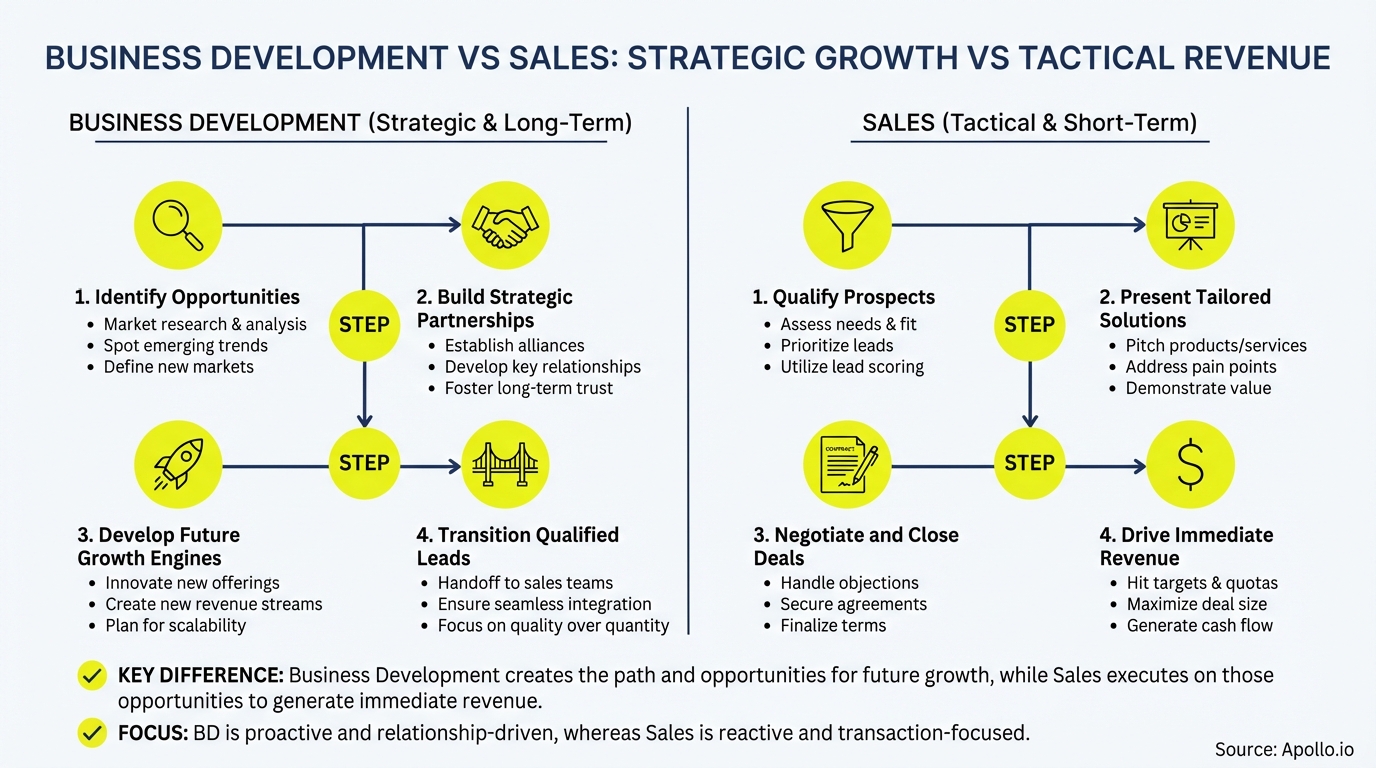
Business development focuses on long-term growth by identifying new markets, building strategic partnerships, and creating opportunities that don't exist yet. Sales converts those opportunities into closed deals and revenue.
Both roles require relationship skills, but business development professionals spend months nurturing partnerships while Account Executives close deals in weeks.
The confusion happens because both teams talk to prospects, but their goals differ fundamentally:
| Function | Business Development | Sales |
|---|---|---|
| Primary Goal | Market expansion, partnerships | Revenue generation, quota attainment |
| Timeline | 3-12 months | 1-3 months |
| Success Metrics | New markets entered, partnerships signed | Deals closed, revenue booked |
| Activities | Market research, strategic meetings, alliance building | Product demos, proposal creation, contract negotiation |
| Typical Handoff | Qualified opportunities to sales | Closed customers to account management |
Struggling to coordinate between BD research and sales execution? Unify your go-to-market teams in one workspace with Apollo.
How Do SDRs Fit Into Business Development vs Sales?
SDRs (Sales Development Representatives) sit between business development and sales, focusing on outbound prospecting and lead qualification. They identify prospects, run initial outreach, and book meetings for Account Executives.
Unlike business development, SDRs work on shorter cycles with clear activity quotas.
SDRs using AI sales tools dramatically improve their efficiency. Research by Gartner shows sellers who effectively partner with AI tools are 3.7 times more likely to meet their quotas. Modern SDRs leverage AI for prospect research, email personalization, and follow-up sequencing.

Key SDR responsibilities include:
- Prospecting targeted accounts using data and intent signals
- Crafting personalized outreach across email, phone, and social channels
- Qualifying leads based on budget, authority, need, and timeline
- Booking qualified meetings for Account Executives
What Tools Do Business Development and Sales Teams Need in 2026?
Both functions need contact data, engagement platforms, and analytics, but many teams waste budget on overlapping tools. The smartest organizations consolidate their tech stack into unified platforms that serve both BD and sales.

Essential capabilities for 2026:
- Verified contact data: Access to 224M+ business contacts with 96% email accuracy
- AI-powered research: Automated prospect intelligence that saves 10+ hours per week
- Multi-channel engagement: Email, phone, and social outreach in one workflow
- Pipeline visibility: Real-time tracking from first touch to closed deal
- Analytics and reporting: Data-driven insights that predict what will close
Data from McKinsey indicates outperforming B2B companies that centralize analytics and data science functions report a 2-5% increase in sales. Consolidation beats fragmentation every time.
Companies using Apollo report significant benefits from consolidating their sales tech stack. As one customer shared: "We reduced the complexity of three tools into one" (Predictable Revenue). Another added: "We cut our costs in half" (Census).
Turn Weak Leads Into Pipeline With Apollo
Marketing leads not converting to opportunities. Apollo scores and enriches every lead with buying signals so your team focuses on ready-to-buy prospects. Built-In boosted win rates 10% with Apollo scoring.
Start Free with Apollo →How Should Business Development and Sales Teams Collaborate?
Effective collaboration requires clear handoff processes, shared visibility into pipeline data, and aligned incentives. Teams fail when BD generates opportunities sales can't close, or when sales ignores strategic accounts BD cultivated.
Best practices for alignment:
- Weekly pipeline reviews: BD and sales leaders review opportunity quality and conversion rates together
- Shared CRM data: Both teams update the same system so nothing falls through cracks
- Clear qualification criteria: Define what makes an opportunity sales-ready before handoff
- Joint account planning: Collaborate on strategy for top-tier strategic accounts
- Unified metrics: Track end-to-end conversion from initial contact to closed revenue
Sales Leaders managing both functions find success with platforms that eliminate silos. "Having everything in one system was a game changer" (Cyera). When BD research, SDR prospecting, and AE deal management happen in one workspace, teams move faster and close more.
Why Are Omnichannel Strategies Critical for Both Functions?
Buyers in 2026 demand flexibility. According to Gartner, 61% of B2B buyers prefer a rep-free buying experience, yet complex deals still require human expertise. Organizations offering both rep-led and self-service interactions are 3.9 times more likely to exceed profit growth expectations.
Business development teams use self-service content to nurture early-stage relationships while reserving high-touch interactions for strategic conversations. Sales teams provide product demos and consultative selling when buyers need guidance, then enable self-service contract review and procurement.
Effective omnichannel elements include:
- Interactive product demos prospects can explore independently
- Knowledge bases with pricing, integrations, and use cases
- Easy meeting scheduling for when buyers want to talk
- Automated sequences that nurture until prospects are ready
Tired of juggling multiple tools for different channels? Run email, phone, and social outreach from one platform with Apollo.
How Do Revenue Operations Teams Support BD and Sales Alignment?
RevOps leaders bridge the gap between business development, sales, and marketing by standardizing processes, maintaining clean data, and providing visibility across the entire revenue funnel. They ensure both teams work from the same source of truth.
RevOps responsibilities that enable BD-sales collaboration:
- Data governance: Maintain contact and account data accuracy across systems
- Process documentation: Define clear handoff criteria and workflows
- Technology management: Reduce tool sprawl and ensure integrations work properly
- Analytics and forecasting: Provide insights that help both teams improve performance
- Territory planning: Assign accounts logically between BD and sales resources
RevOps teams increasingly favor platforms that consolidate functionality. Managing three separate systems for prospecting, engagement, and analytics creates integration headaches and data inconsistencies.
Unified platforms eliminate those problems while cutting costs.
Start Aligning Your Business Development and Sales Teams
The distinction between business development and sales matters less than how well they work together. Teams that share data, align on processes, and use unified technology outperform competitors still operating in silos.
In 2026, the winning formula combines AI-powered efficiency with human strategic thinking. Business development identifies the right opportunities while sales closes them efficiently.
Both functions need accurate data, intelligent automation, and seamless collaboration.
Modern teams consolidate their tech stack to improve alignment and reduce costs. Instead of separate tools for BD research, SDR prospecting, and AE deal management, leading organizations use all-in-one platforms that serve every revenue function.
Ready to unify your go-to-market team? Start a free trial of Apollo and see how 2M+ users manage business development, sales development, and account execution in one workspace.
Prove Apollo's ROI In Your First 30 Days
Budget approval stuck on unclear metrics? Apollo tracks every dollar spent to pipeline generated—quantify time saved, meetings booked, and deals closed. Customer. io achieved 50% YoY growth with measurable impact.
Start Free with Apollo →Don't miss these
Sales
Inbound vs Outbound Marketing: Which Strategy Wins?
Sales
What Is a Sales Funnel? The Non-Linear Revenue Framework for 2026
Sales
What Is a Go-to-Market Strategy? The 2026 GTM Playbook
See Apollo in action
We'd love to show how Apollo can help you sell better.
By submitting this form, you will receive information, tips, and promotions from Apollo. To learn more, see our Privacy Statement.
4.7/5 based on 9,690 reviews
