
What Are the Best B2B Examples That Actually Drive Growth in 2026?
B2B companies operate differently than B2C, selling products and services to other businesses rather than individual consumers. From SaaS platforms to manufacturing suppliers, successful B2B examples share common traits: they solve specific business problems, build long-term relationships, and leverage data to personalize their approach.
In 2026, research by Gartner shows that 92% of businesses are investing in AI-powered software, while 98% of buyers consider customer reviews critical in their purchase decisions. The B2B landscape has shifted toward technology consolidation, AI-driven personalization, and proof-driven decision-making.

Apollo Finds Verified Contacts In Seconds
Tired of spending 4+ hours daily hunting for contact info? Apollo delivers 224M+ verified contacts with 96% email accuracy. Join 550K+ companies who eliminated manual research.
Start Free with Apollo →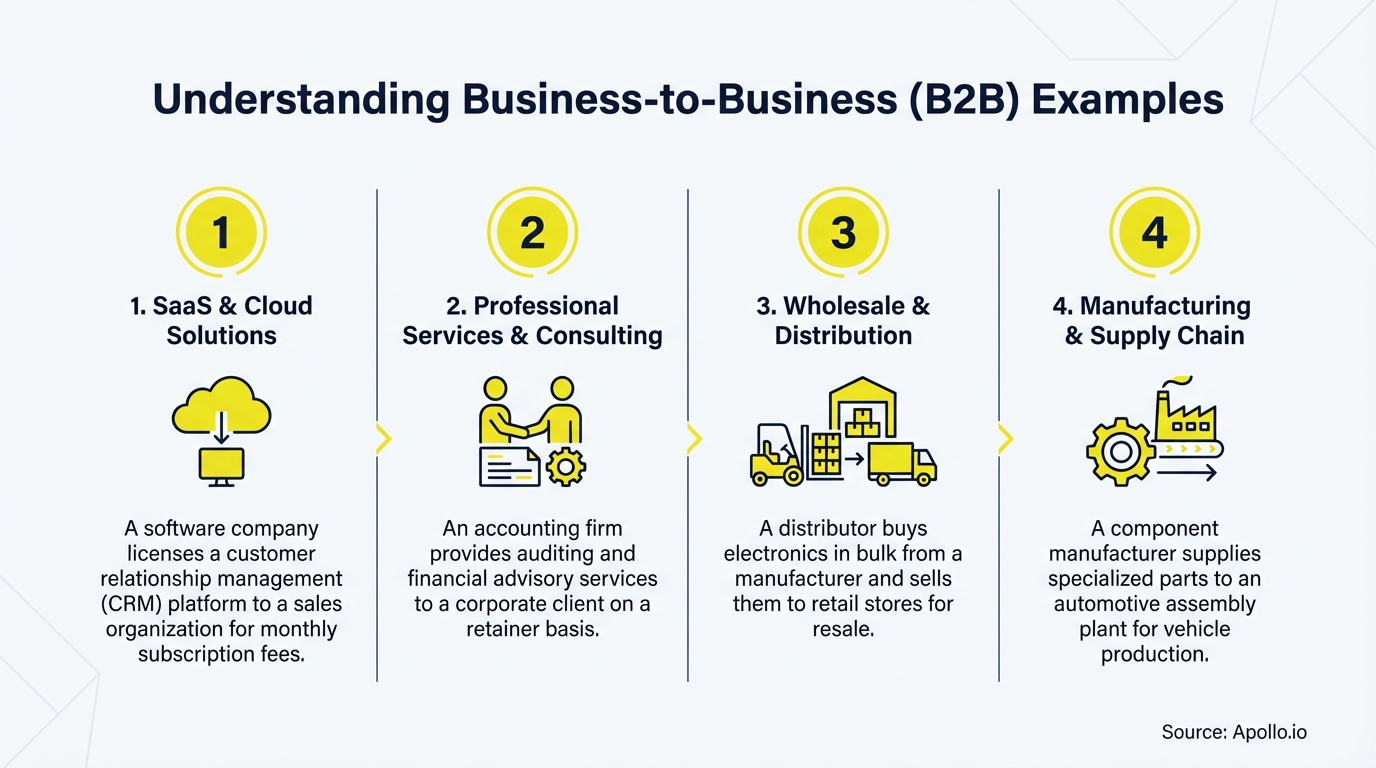
Key Takeaways
- B2B (business-to-business) involves companies selling to other companies, not individual consumers
- Successful B2B models include SaaS, marketplace platforms, data providers, and professional services
- In 2026, AI personalization, tech stack consolidation, and customer reviews drive B2B buying decisions
- Effective B2B marketing combines LinkedIn outreach, content strategy, and multi-channel engagement
- Platforms like Apollo unify prospecting, enrichment, and engagement in one workspace to cut costs and increase efficiency
What Is B2B and Why Does It Matter?
B2B stands for business-to-business, describing transactions where one company sells products or services to another company. Unlike B2C (business-to-consumer), B2B sales involve longer decision cycles, multiple stakeholders, and higher transaction values.
B2B relationships prioritize business contact information—professionals acting in their business capacity—not personal consumer data. Companies target decision-makers like sales leaders, RevOps teams, and procurement managers who evaluate solutions based on ROI, integration capabilities, and vendor reputation.
According to Statista, online B2B advertising and marketing expenses are expected to reach nearly 39% of total spending by 2026, reflecting the shift toward digital-first strategies.
What Are the Most Successful B2B Business Models?
B2B business models vary widely across industries, but the most scalable share common characteristics: recurring revenue, data-driven insights, and technology integration.

SaaS and Software Platforms
Software-as-a-Service (SaaS) dominates B2B growth. Companies like Salesforce, HubSpot, and Apollo provide cloud-based tools with subscription pricing, enabling businesses to access powerful features without heavy upfront costs.
"Apollo could be a third of the cost if you look at the full price of what we were spending on ZoomInfo, Outreach, Salesforce, and admins to make it all work."
SaaS platforms win by offering tool consolidation—replacing multiple point solutions with one unified workspace. This reduces training time, eliminates data silos, and cuts tech stack expenses significantly.
B2B Marketplaces and Data Providers
Marketplace platforms connect buyers and sellers, monetizing through transaction fees or subscriptions. Examples include Alibaba (wholesale goods), Thomasnet (industrial suppliers), and UpWork (freelance services).
Data providers like Apollo's B2B Data Network supply verified contact information, firmographic details, and intent signals. Businesses rely on accurate data to fuel outbound campaigns and enrich CRM records.
Professional Services and Consulting
B2B services—from management consulting (McKinsey, Deloitte) to marketing agencies—sell expertise and execution. These models thrive on relationship-building, case studies, and referrals.
Success hinges on demonstrating measurable outcomes. Agencies increasingly adopt B2B marketing strategies that showcase client ROI through detailed reporting and testimonials.
How Do B2B Companies Execute Effective Marketing?
B2B marketing differs fundamentally from B2C. Buyers research extensively, compare vendors, and seek peer validation before committing.
Effective strategies combine educational content, social proof, and multi-channel outreach.
Content-Driven Demand Generation
Educational content—whitepapers, case studies, webinars—positions companies as thought leaders. B2B marketing funnels nurture prospects from awareness to decision through targeted content at each stage.
In 2026, AI-powered personalization tailors messaging to individual buyer needs. Tools analyze firmographics, technographics, and engagement history to deliver relevant content at scale.
"With this kind of AI system, my BDRs can send 10x more personalized emails. Their productivity and growth has skyrocketed."
LinkedIn and Social Selling
LinkedIn dominates B2B social media. Forrester reports that 87% of companies maintain a paid relationship with LinkedIn, using it for targeted ads, thought leadership, and direct outreach.
Sales teams leverage LinkedIn to identify decision-makers, engage with content, and initiate conversations. Pairing LinkedIn with B2B email marketing creates multi-touch sequences that increase response rates.
Account-Based Marketing (ABM)
ABM targets high-value accounts with personalized campaigns. Instead of broad outreach, teams focus resources on specific companies, tailoring messaging to stakeholder roles and pain points.
Struggling to identify and engage target accounts? Search Apollo's 224M+ contacts with 65+ filters to build precise account lists and launch targeted ABM plays.
| Marketing Tactic | Best Use Case | Key Metric |
|---|---|---|
| Content Marketing | Demand generation, SEO | Organic traffic, lead conversions |
| LinkedIn Ads | Targeting decision-makers | Click-through rate, engagement |
| Email Sequences | Nurturing leads, demos | Open rate, reply rate |
| Webinars | Product education, lead capture | Registrations, attendance rate |
| Account-Based Marketing | Enterprise deals, high-value accounts | Account engagement, pipeline value |
What B2B Sales Strategies Close More Deals?
B2B sales require relationship-building, consultative selling, and persistence. Decision cycles span weeks or months, involving multiple stakeholders and budget approvals.
Outbound Prospecting with AI Research
Outbound remains critical for B2B growth. Sales teams use proven B2B sales strategies to identify prospects, craft personalized messaging, and book meetings.
AI research agents analyze company websites, news, and social signals to generate talking points. Reps spend less time researching and more time selling.

Multi-Channel Engagement
Top performers combine phone, email, LinkedIn, and direct mail. Multi-channel sequences increase touchpoints without overwhelming prospects.
Spending hours on manual outreach? Automate your sequences with Apollo to trigger emails, calls, and LinkedIn tasks based on prospect behavior.
Customer Reviews and Social Proof
Buyers trust peer reviews over vendor claims. Showcasing testimonials, case studies, and G2 ratings builds credibility and accelerates decisions.
Companies highlight specific outcomes—like increased meetings booked or cost savings—to demonstrate tangible value. Reviews influence 98% of software purchase decisions, making social proof non-negotiable in 2026.
How Do B2B Partnerships Drive Growth?
Strategic partnerships expand market reach, add complementary capabilities, and create co-selling opportunities. Successful B2B partnerships align on target customers, integrate technology, and share revenue models.
Examples include technology integrations (Salesforce + Slack), reseller agreements (AWS + consulting firms), and co-marketing initiatives (HubSpot + agency partners). Partnerships work when both sides deliver measurable value to shared customers.
What Role Does Technology Play in B2B Success?
Technology consolidation defines the 2026 B2B landscape. Companies cut costs by replacing multiple tools with all-in-one platforms that unify prospecting, engagement, and deal management.
Key technologies include:
- CRM systems for managing customer relationships and pipeline
- Sales intelligence platforms providing verified contact data and firmographics
- Engagement tools automating email sequences, calls, and LinkedIn outreach
- Conversation intelligence analyzing calls and meetings for coaching insights
- Revenue operations platforms aligning sales, marketing, and customer success
Platforms like Apollo eliminate the need for separate tools like ZoomInfo, Outreach, and Gong, delivering significant cost savings and operational efficiency. Companies report cutting tech stack expenses in half while doubling productivity.
See Every Deal Stage In Real Time With Apollo
Pipeline forecasting a guessing game? Apollo gives you real-time visibility across every deal stage so you can forecast with confidence. Built-In increased win rates 10% with Apollo's scoring and signals.
Start Free with Apollo →What Are Real-World B2B Success Stories?
Companies across industries leverage B2B strategies to scale revenue and improve efficiency. Common themes include data-driven targeting, AI personalization, and unified platforms.
For example, lead generation companies use Apollo to identify prospects, enrich records, and launch personalized sequences—all in one workspace. They report higher connect rates, more meetings booked, and faster sales cycles.
Enterprise teams adopt enterprise sales solutions to coordinate multi-stakeholder deals, track engagement, and forecast pipeline accurately. The result: larger deal sizes and predictable revenue growth.
Conclusion: Apply These B2B Examples to Your Growth Strategy
Successful B2B companies share core principles: they solve specific business problems, leverage data for personalization, build long-term relationships, and consolidate technology to increase efficiency.
In 2026, the best B2B strategies combine AI-powered tools, multi-channel engagement, and customer reviews to win deals faster. Whether you're in SaaS, services, or data, focus on delivering measurable ROI and simplifying the buyer journey.
Ready to transform your B2B strategy? Schedule a Demo to see how Apollo's all-in-one platform unifies prospecting, engagement, and deal execution in one workspace.
Prove Apollo's ROI In Your First 30 Days
Budget approval stuck on unclear metrics? Apollo tracks every dollar—from prospect to closed deal. Built-In increased win rates 10% and ACV 10% with Apollo's scoring and signals.
Start Free with Apollo →Don't miss these
Sales
Inbound vs Outbound Marketing: Which Strategy Wins?
Sales
What Is a Sales Funnel? The Non-Linear Revenue Framework for 2026
Sales
What Is a Go-to-Market Strategy? The 2026 GTM Playbook
See Apollo in action
We'd love to show how Apollo can help you sell better.
By submitting this form, you will receive information, tips, and promotions from Apollo. To learn more, see our Privacy Statement.
4.7/5 based on 9,690 reviews
