AI GTM Engineer: The Revenue Strategist Building Autonomous Go-to-Market Systems
Job postings for GTM engineers jumped from 1,400 in mid-2025 to over 3,000 by January 2026, signaling a fundamental shift in how companies build revenue infrastructure.
The AI GTM engineer isn't just another automation specialist. They're revenue strategists who architect AI-powered systems that turn go-to-market strategy into repeatable, measurable execution — without duct-taping together a dozen disparate tools.
This emerging role bridges the gap between AI adoption and AI scaling. According to SerpSculpt, 78% of all B2B companies utilize AI across at least one business function as of 2025, yet most haven't scaled these implementations enterprise-wide.
For a comprehensive overview of the GTM engineer role and its core responsibilities, see our guide on GTM Engineer.

Turn 4+ Hours Of Research Into Minutes
Tired of reps spending half their day hunting for contact info? Apollo delivers 224M verified contacts instantly so your team can focus on selling. Join 550K+ companies closing more deals.
Start Free with Apollo →Key Takeaways
- AI GTM engineers build revenue systems, not tool integrations — they architect end-to-end workflows that connect signals, scoring, personalization, and measurement
- The role emerged from CAC pressure and stack complexity, with companies spending roughly $2 in sales and marketing to earn $1 in new ARR
- Success requires technical skills (APIs, data pipelines, AI orchestration) plus strategic thinking (revenue attribution, experimentation design, governance frameworks)
- Organizations are shifting from GenAI pilots to agentic AI systems, with 23% already scaling AI agents somewhere in the enterprise
- The endgame is Agentic GTM — autonomous revenue operations where AI handles research, routing, and personalization while humans focus on judgment and relationships
What Is An AI GTM Engineer?
An AI GTM engineer is a revenue systems architect who designs, builds, and optimizes AI-powered go-to-market infrastructure.
Unlike traditional marketing ops or sales ops roles that maintain existing systems, AI GTM engineers create new capabilities — signal pipelines that feed scoring models, AI-generated personalization workflows, and instrumentation that proves what's actually driving revenue. They turn GenAI from an experimental tool into production-grade infrastructure.
The role sits at the intersection of data engineering, revenue operations, and AI enablement. Research from Digital Commerce 360 shows 91% of respondents in Allego's 2025 AI in Revenue Enablement Report plan to increase AI spending over the next 12 months, creating massive demand for professionals who can operationalize these investments.
This isn't about building Zapier workflows or configuring CRM fields. It's about architecting the technical foundation that allows marketing, sales, and customer success to execute strategy at machine speed with human oversight.
Why Are Companies Hiring AI GTM Engineers Now?
Three converging forces created this role in 2025-2026.
First, customer acquisition costs exploded while revenue efficiency collapsed. Companies now spend approximately $2 in sales and marketing expenses to generate $1 in new annual recurring revenue — up 14% year-over-year.
Manual GTM processes can't deliver the productivity gains needed to restore healthy unit economics.
Second, tool sprawl reached a breaking point. The average GTM stack now includes 10-15 disconnected platforms for data enrichment, engagement, intent signals, and CRM.
Each integration creates fragility, and every workflow requires human intervention to move data between systems.
Third, AI agents moved from experimentation to early production. Data from Cubeo.ai indicates that by the end of 2025, nearly 85% of enterprises are expected to implement AI agents into their workflows. Someone needs to wire these agents into existing revenue operations, define their scope, and measure their impact.
The AI GTM engineer emerged as the answer to all three problems.

What Does An AI GTM Engineer Actually Build?
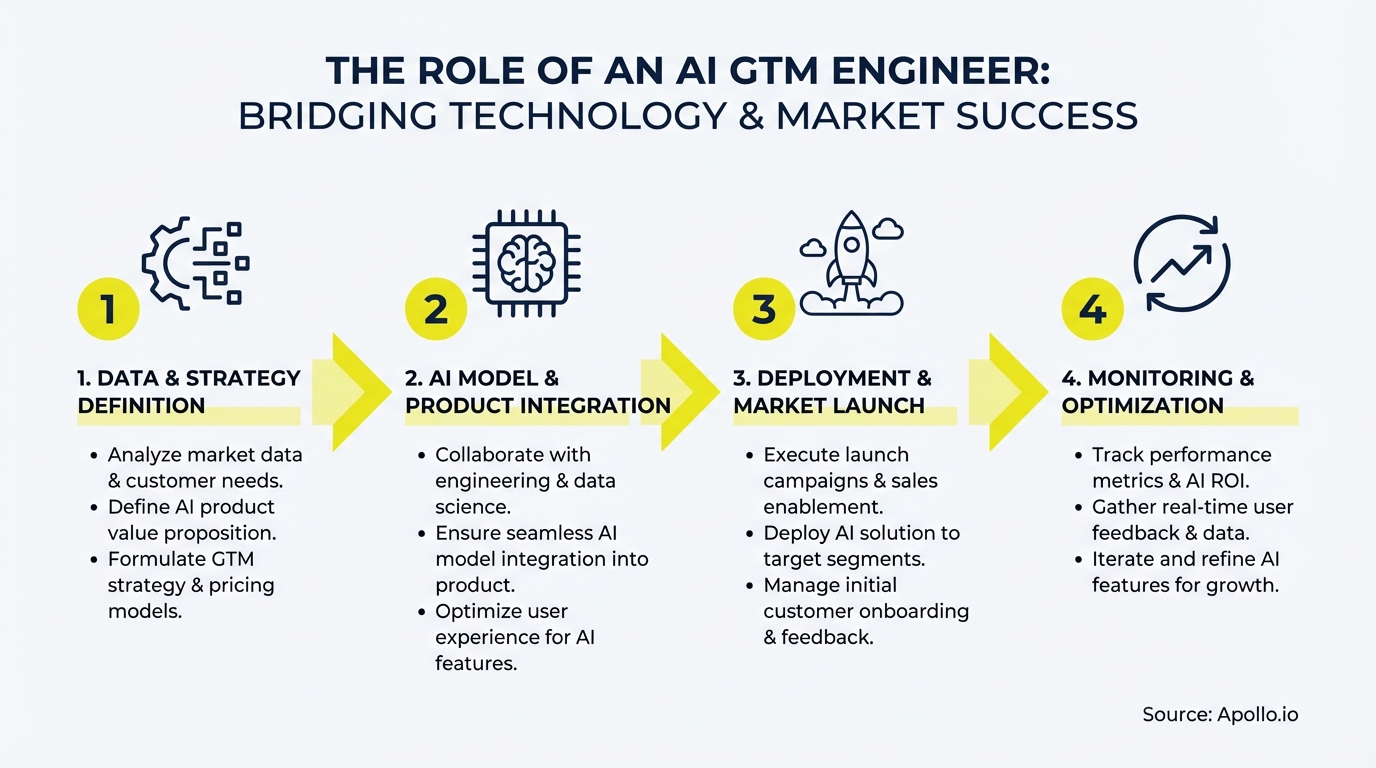
AI GTM engineers architect five core systems that most companies currently handle through manual processes or fragmented tools.
Signal infrastructure connects first-party data (CRM, website behavior, product usage), second-party data (B2B intelligence platforms), and third-party intent signals into a unified scoring system. Instead of building one-off lists around single triggers, the system continuously ranks every account in your total addressable market based on fit, intent, timing, and engagement.
AI-powered personalization workflows generate contextual messaging at scale.
These aren't mail-merge templates — they're multi-signal systems that reference hiring patterns, news events, technology changes, and engagement history to create messaging that sounds like your best rep wrote it.
The AI GTM engineer builds the prompt architecture, defines the review process, and instruments feedback loops that improve output quality over time.
Routing and orchestration logic determines what happens when signals fire. If a high-priority account visits your pricing page, should they enter an email sequence, get routed to an SDR for immediate outreach, or trigger a Slack notification to the account executive? The AI GTM engineer defines these rules and builds the workflows that execute them automatically.
Governance frameworks ensure AI systems stay on-brand and compliant. This includes content approval processes, data handling policies, and quality assurance checkpoints that catch errors before they reach prospects. These safeguards make the difference between experimental AI tools and production-grade revenue infrastructure.
Attribution and measurement systems prove what's working. The AI GTM engineer doesn't just track campaign metrics — they instrument the entire funnel to show which signals predict conversion, which personalization approaches drive meetings, and which accounts are most likely to close based on engagement patterns.
Struggling to scale your AI-powered outreach without sacrificing quality? See how Apollo's AI sales automation handles personalization, sequencing, and governance in one unified platform.
How Do AI GTM Engineers Differ From Traditional RevOps?
RevOps maintains and optimizes existing revenue operations. AI GTM engineers build new technical capabilities that didn't exist before.
A RevOps professional might configure Salesforce workflows, manage data hygiene, and produce dashboards that track pipeline health. An AI GTM engineer writes Python scripts that enrich contact records with real-time signals, architects prompt chains that generate personalized messaging, and builds scoring models that predict which accounts will convert.
The skill sets overlap but diverge in important ways. Both roles need deep CRM knowledge and analytical thinking.
But AI GTM engineers require programming skills (Python, SQL, API integration), AI/ML fundamentals (prompt engineering, model evaluation, fine-tuning concepts), and data engineering capabilities (ETL pipelines, webhook orchestration, data warehouse integration).
For a detailed comparison of these complementary roles, see our analysis of gtm engineer vs revops.
The relationship is collaborative, not competitive. RevOps owns the steady-state operation of revenue systems.
AI GTM engineers build the next generation of those systems, then hand them off to RevOps for ongoing maintenance and optimization.
What Technical Skills Do AI GTM Engineers Need?
The role demands both technical depth and strategic breadth.
| Skill Category | Core Competencies | Why It Matters |
|---|---|---|
| Programming & APIs | Python, SQL, REST APIs, webhook integration | Build custom data pipelines and connect disparate systems without relying on pre-built connectors |
| AI & Prompt Engineering | LLM capabilities, prompt design, output evaluation, model selection | Design AI workflows that generate high-quality, on-brand content at scale with minimal human review |
| Data Architecture | Data warehousing, ETL processes, schema design, data governance | Create unified signal repositories that feed scoring, routing, and personalization systems |
| Revenue Operations | CRM architecture, lead scoring, attribution models, funnel analytics | Ensure technical solutions actually drive revenue outcomes and integrate with existing GTM processes |
| Experimentation & Measurement | A/B testing, statistical significance, correlation analysis, incrementality testing | Prove which AI-powered interventions actually improve conversion rates and pipeline velocity |
Most AI GTM engineers come from one of three backgrounds: software engineering with revenue context, data science with GTM exposure, or senior RevOps roles with strong technical skills.
The fastest path into the role typically involves building AI-powered systems in your current GTM organization. Start with a high-impact use case (signal-based lead scoring, AI-generated email personalization, automated data enrichment), prove ROI, then expand scope.
For a roadmap on developing these capabilities, explore how to become a gtm engineer.
What Does The AI GTM Engineer Build In The First 90 Days?
High-performing AI GTM engineers follow a systematic rollout that proves value quickly while building toward comprehensive automation.
Apollo Finds Your Exact Buyers Instantly
Running out of qualified leads to fill your pipeline. Apollo delivers 224M verified contacts with 96% email accuracy so your team focuses on closing, not searching. Join 550K+ companies hitting their numbers.
Start Free with Apollo →| Phase | Timeframe | Key Deliverables |
|---|---|---|
| Foundation | Days 1-30 | Complete TAM build, signal audit, data pipeline architecture, and baseline metrics documentation |
| Intelligence Layer | Days 31-60 | Deploy scoring model, implement AI personalization workflows, establish human-in-the-loop review process |
| Automation & Scale | Days 61-90 | Launch automated sequences, build attribution dashboards, document governance policies, train revenue teams |
The first 30 days focus on understanding your total addressable market and mapping existing data sources. This means building a complete list of every company that could buy from you, documenting which signals you can access (firmographic data, intent signals, engagement history, product usage), and identifying gaps in your current data infrastructure.
Days 31-60 introduce intelligence. You build the scoring model that ranks accounts based on what actually predicts conversion in your business.
You implement AI-generated personalization for high-priority segments. You establish review workflows so sales leaders can approve AI output before it reaches prospects.
The final 30 days focus on automation and measurement. Sequences run automatically for qualified accounts.
Dashboards show which signals correlate with closed deals. Documentation ensures RevOps can maintain the system after handoff.
Training gives SDRs and AEs the context they need to trust and leverage the new infrastructure.
For teams looking to operationalize this framework, Apollo offers the GTM Engineering (GTME) Program — a 12-week engagement where a dedicated Go-to-Market Engineer builds, implements, and optimizes a complete GTM system around your strategy, collapsing the typical Frankenstack into one unified workflow without requiring months of internal experimentation.
How Do AI GTM Engineers Measure Success?
The best AI GTM engineers instrument systems to prove incremental impact, not just activity metrics.
System health metrics confirm the infrastructure is working correctly. These include data refresh completeness (percentage of accounts with current signals), scoring model coverage (percentage of TAM ranked and prioritized), and sequence automation rate (percentage of qualified accounts entering workflows without manual intervention).
Performance metrics show whether AI-powered systems outperform manual processes.
Track reply rates by personalization approach (generic template vs AI-generated vs human-written).
Measure meeting conversion rates by account score tier.
Calculate pipeline contribution from AI-assisted outreach vs traditional prospecting.
Efficiency metrics quantify time savings and cost reduction. Document how much time SDRs spend on research before and after signal infrastructure launches. Calculate the cost per qualified lead using your integrated platform vs maintaining separate tools for data enrichment, engagement, and intent signals.
Revenue metrics prove bottom-line impact. Correlate account scores with win rates to validate your prioritization model. Track sales cycle length for accounts engaged through AI-powered sequences vs traditional outreach. Measure quota attainment for reps using AI-generated personalization vs those who don't.
The most sophisticated AI GTM engineers run controlled experiments — A/B tests where similar accounts receive different treatments, allowing you to isolate the incremental lift from each AI-powered intervention.

What Governance Frameworks Do AI GTM Engineers Need?
Production-grade AI systems require explicit policies around content quality, data handling, and compliance.
Content approval workflows define who reviews AI-generated messaging before it reaches prospects. For enterprise accounts or highly regulated industries, this might mean human review of every message. For mid-market accounts with proven AI performance, it might mean spot-checking a sample. The AI GTM engineer builds the routing logic that sends high-risk content for review while allowing low-risk content to deploy automatically.
Brand voice guidelines train AI systems to match your company's messaging style. This includes example emails that represent your tone, topics to avoid, and formatting preferences. The AI GTM engineer translates these guidelines into prompt instructions and evaluation criteria that maintain consistency across thousands of generated messages.
Data handling policies specify which information AI systems can access and how they can use it. Can the personalization engine reference private customer data? Which intent signals are acceptable to mention in outreach? How long do you retain AI-generated content? These policies protect both your prospects and your company.
Quality assurance checkpoints catch errors before they cause damage. This includes automated filters that flag messages with competitor mentions, profanity, or broken links. It includes human review cycles where marketing leaders spot-check AI output weekly. It includes feedback mechanisms where reps can report low-quality messages so the system improves over time.
Compliance documentation proves your AI systems meet regulatory requirements. This matters especially for financial services, healthcare, and companies selling into the EU. The AI GTM engineer maintains records showing which AI models you use, how you train them, what data they access, and how you monitor their output.
How Are Companies Structuring AI GTM Engineer Roles?
Most organizations embed AI GTM engineers in one of three places depending on their GTM maturity.
Early-stage companies (Series A-B) often make the founder or an early revenue leader the de facto AI GTM engineer. They build initial systems themselves, then hire a dedicated engineer once the business reaches $5-10M ARR and needs to scale beyond founder-led automation.
Growth-stage companies (Series B-C) typically hire AI GTM engineers into RevOps or a newly created GTM operations function. These engineers report to the CRO or VP of Revenue Operations and work across marketing, sales, and customer success to build unified systems.
Enterprise organizations build dedicated GTM engineering teams with specialized roles. One engineer might focus on data infrastructure and signal pipelines. Another owns AI personalization and content generation. A third specializes in attribution modeling and experimentation. This structure makes sense once you're managing dozens of workflows across multiple segments and regions.
The reporting structure matters less than the mandate. Successful AI GTM engineers have executive sponsorship, cross-functional authority, and clear success metrics tied to revenue outcomes.
Need help building your first signal-based scoring system? Apollo's data enrichment platform provides 224M+ verified contacts and 65+ filters to build comprehensive TAM lists and prioritization models.
What Does The Future Hold For AI GTM Engineers?
The role is evolving rapidly from systems builder to agentic orchestrator.
Today's AI GTM engineer architects workflows where AI generates content and humans review it. Tomorrow's AI GTM engineer will design autonomous agents that research accounts, personalize messaging, send outreach, interpret replies, and schedule meetings — all without human intervention except for edge cases and strategic decisions.
This shift is already happening. Sales leaders are deploying AI SDRs into production, not just running pilots.
The bottleneck isn't AI capability — it's the infrastructure that makes AI safe, measurable, and integrated with existing revenue operations.
That's exactly what AI GTM engineers build. They create the guardrails that keep autonomous agents on-brand.
They instrument the attribution models that prove which AI-powered interventions drive revenue. They design the escalation logic that routes edge cases to human reps when AI reaches its limits.
The endgame is Agentic GTM — where AI handles the majority of research, routing, and execution while humans focus on strategic decisions, complex negotiations, and relationship building. Research from Rev Empire shows 87% of companies identify AI as a top priority in their 2025 business plans, signaling massive investment in the infrastructure that makes Agentic GTM possible.
The AI GTM engineers building these systems today are defining the revenue operations architecture that will power go-to-market execution for the next decade.
Prove Apollo's ROI In Your First Quarter
Budget approval stuck on unclear metrics? Apollo delivers measurable pipeline growth with built-in attribution tracking. Built-In increased win rates 10% and ACV 10% using Apollo's signals.
Start Free with Apollo →Ready to build your AI-powered GTM infrastructure without duct-taping together a dozen tools? Try Apollo Free and experience the unified platform where 2M+ users manage prospecting, engagement, enrichment, and analytics in one elegant workflow designed for the Agentic GTM era.
Don't miss these
Sales
Inbound vs Outbound Marketing: Which Strategy Wins?
Sales
What Is a Sales Funnel? The Non-Linear Revenue Framework for 2026
Sales
What Is a Go-to-Market Strategy? The 2026 GTM Playbook
See Apollo in action
We'd love to show how Apollo can help you sell better.
By submitting this form, you will receive information, tips, and promotions from Apollo. To learn more, see our Privacy Statement.
4.7/5 based on 9,690 reviews
